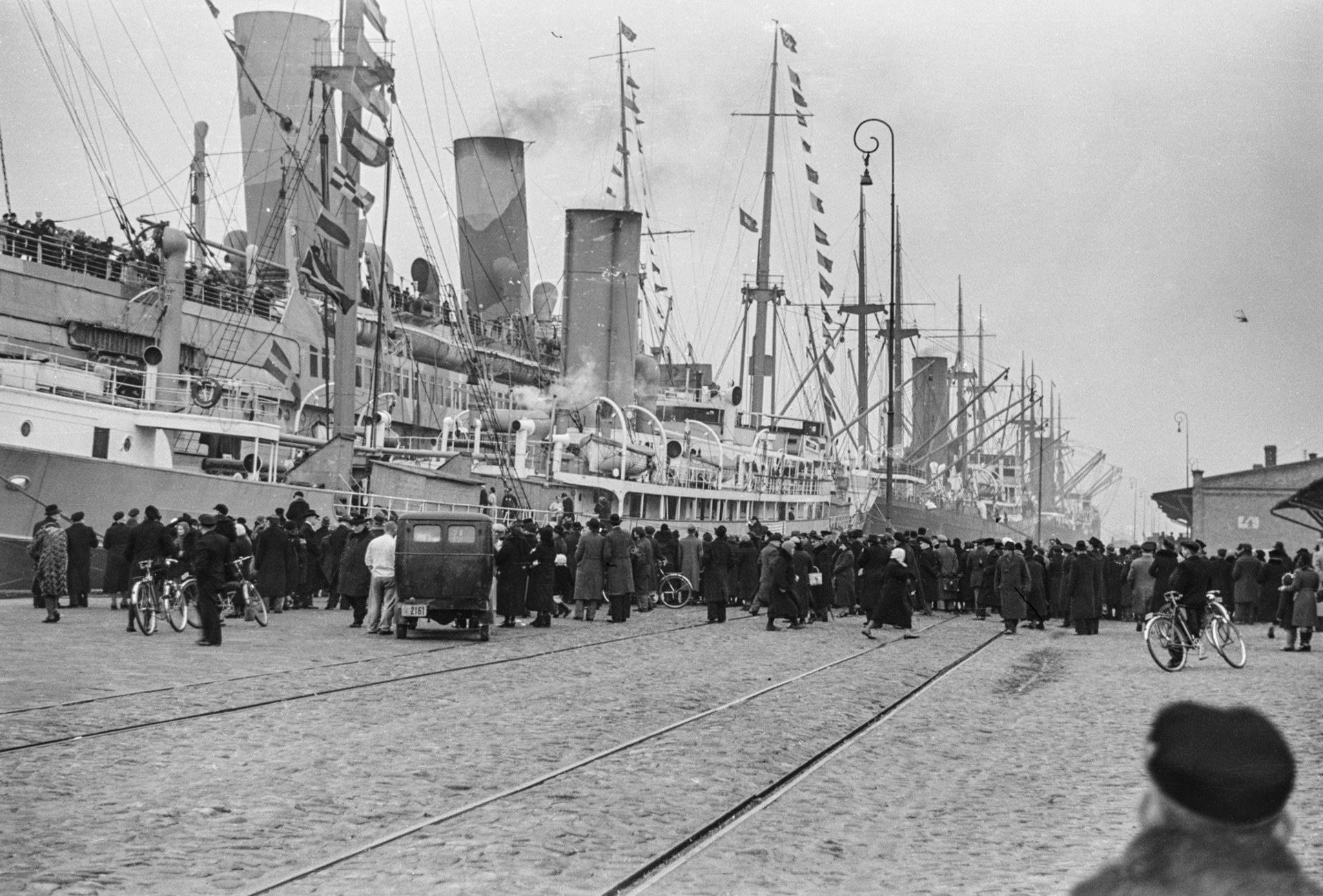

Baltic Germans Exodus – accidentally found photographic evidence from 1939. Valdis Gavars Collection
The exhibition “Baltic German exodus – accidentally found photographic evidence of 1939. Valdis Gavars collection” is on display at Mentzendorff’s House from June 30 to September 6, 2026.
The Molotov–Ribbentrop Pact, signed on August 23, 1939, between Germany and the Union of Soviet Socialist Republics (USSR), brought about a series of tragic changes in Latvian public life. One of these turning points was the Baltic German exodus, which took place from the end of 1939 to the spring of 1941. Preparations for the exodus began after Adolf Hitler’s call to “return to the Reich” on October 6, 1939. On October 30, 1939, Latvia and Germany signed an agreement on the relocation of Latvian citizens of German nationality to Germany. As a result of these events, about 50,000 Baltic Germans left Latvia. Baltic German families set off for an unknown future by ships from the ports of Riga, Liepāja and Ventspils, leaving behind in Latvia their real estates that has been cherished for generations, relatives, friends and indescribable emotional values.
The moments captured in the documentary photographs exhibited in the exhibition depict the exodus of Baltic Germans from Riga in November 1939. Finding these photographic evidence and getting them to the exhibition is a plot worthy of a historical detective. As a result of a series of coincidences, the photo negatives taken more than 80 years ago came into the sight of Valdis Gavars. “In 2024, I noticed that old films were being offered on the Internet. I found them interesting, and I bought the films,” says Valdis Gavars.
The new owner of the negatives understood their historical significance, and photo restorer Rihards Puriņš carried out a complex restoration of the photographic films. Thanks to the passion of both gentlemen for the history of Latvia and their specific actions, today everyone can look at the emotionally charged moments of the dramatic events of 1939 captured by a camera.
Restorer Rihards Puriņš, believing that the photographs are of a high standard, has begun searching for their author. With the help of his German colleagues, he has tried to find out who recorded the specific event. As a result, it was concluded that there is a reasonable version that the author of the photographs is Wilhelm Holtfreter, whose photo collections are kept in the Bundesarchiv. There is something still undiscovered and mysterious in this story that tempts further research.
The collection accidentally found by Valdis Gavars, professionally restored and prepared for exhibition, is evidence of the past, a fragment of a historical mosaic that reveals, allows us to learn and get the emotional experience.